The Impact of Network Topology on Performance Metrics and Energy Consumption for Blockchains: Towards Repeatable Benchmarking
This ACM DLT journal publication presents the topology-aware blockchain benchmarking line of work behind my PhD research. The article studies how network structure, workload shape, and controlled experimental assumptions influence blockchain performance, moving beyond evaluations that treat the network as an opaque or secondary execution layer.
Authors
Vincenzo P. Di Perna, Valerio Schiavoni, Miguel Matos, Francesco Fabris, and Marco Bernardo
Publication
ACM DLT journal article
DOI: 10.1145/3828757
5
blockchain systems
5
network topologies
6
workload families
DOI
10.1145/3828757
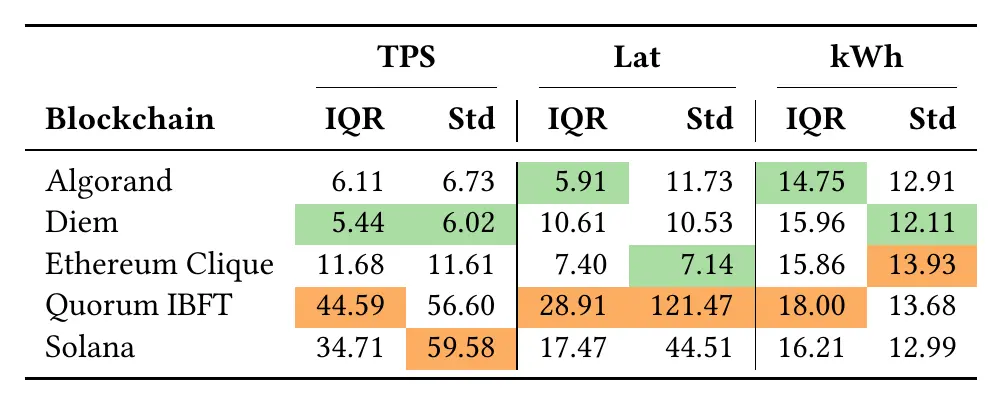
What the journal article highlights
Blockchain performance is not only a property of the protocol or the machines used during an experiment. It also depends on how nodes are connected, how messages propagate, how workloads stress the system, and how stable the experimental environment is. This publication makes that dependency explicit by placing network topology at the centre of the evaluation methodology.
- Treats the network topology as a first-class experimental variable rather than as a hidden deployment detail.
- Connects blockchain throughput, latency, commit behaviour, and workload sensitivity with controlled network structures.
- Builds on the Lilith benchmarking pipeline to support reproducible, topology-aware blockchain evaluation.
- Strengthens the research line developed during my PhD on performance, energy, repeatability, and realistic experimental conditions.
Experimental perspective
The research line compares blockchain systems under controlled network topologies such as fat-tree, full mesh, hypercube, scale-free, and torus. These topologies are used as experimental lenses: they make it possible to observe how different communication structures affect throughput, latency, commit ratio, network load, and robustness.
Performance
Throughput, latency, commit behaviour, and workload sensitivity are interpreted in relation to the network conditions under which the system is executed.
Reproducibility
The work uses controlled experimental assumptions to reduce hidden variability and make blockchain comparisons easier to repeat and interpret.
Network awareness
The article reinforces the idea that blockchain benchmarking should model the network explicitly instead of abstracting it away as neutral infrastructure.
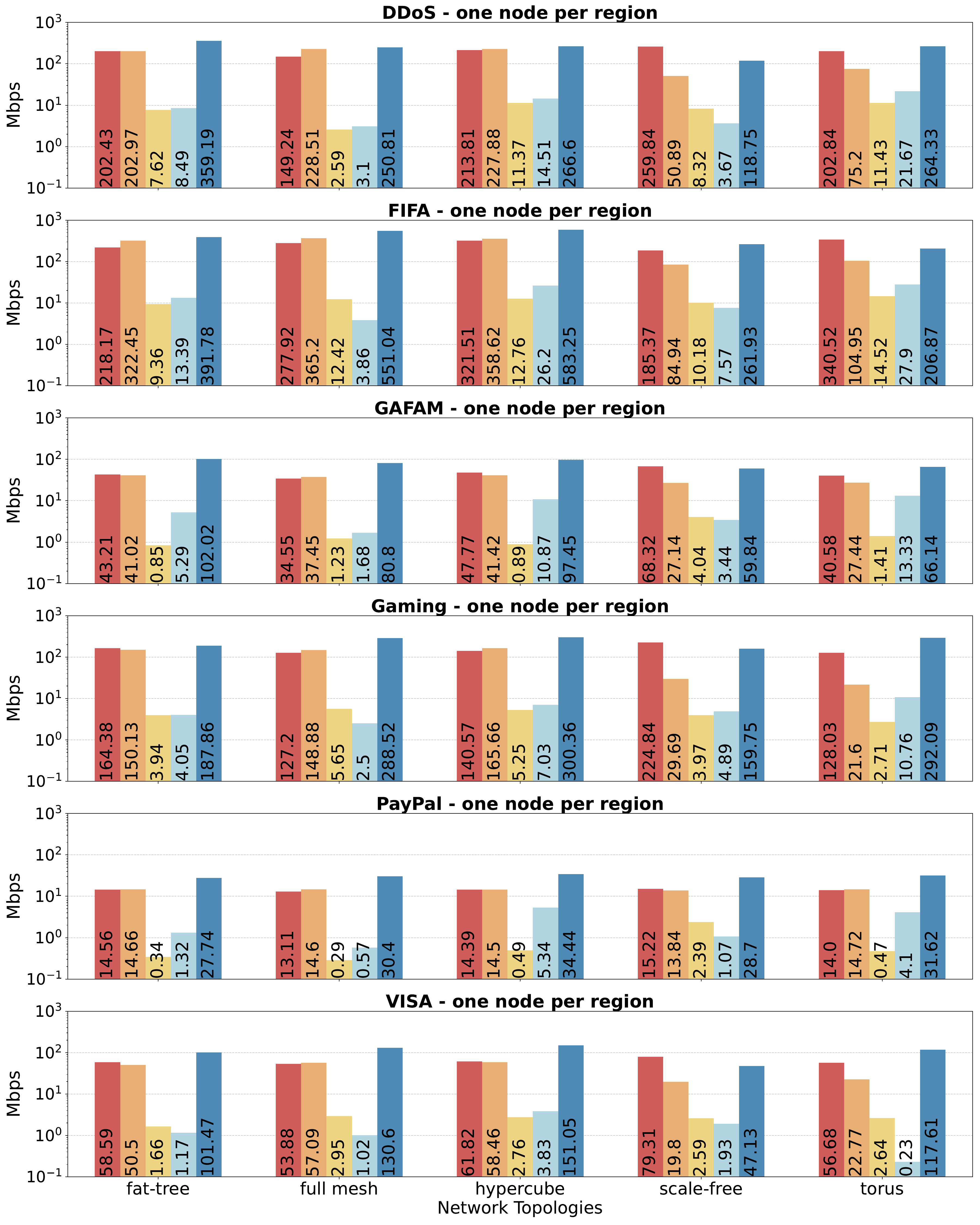
Connection to my PhD work
This publication is directly connected to my doctoral dissertation, which compares blockchain systems across performance, energy, repeatability, predictability, and economic-efficiency dimensions. It represents the journal-facing part of the broader topology-aware benchmarking contribution, alongside the Lilith artifact and the conference publications on performance and energy evaluation.