Blockchain Energy Consumption: Unveiling the Impact of Network Topologies
IEEE ICBC '25 PublicationThis work studies how network topology influences the energy consumption of blockchain systems. The paper evaluates multiple blockchain platforms under controlled topologies and realistic workloads, measuring not only total energy usage but also energy per transaction.
5
blockchain systems
5
network topologies
3
workload models
RAPL
energy measurements
Context
Blockchain energy consumption is often discussed in relation to consensus mechanisms and hardware requirements. However, the network layer also affects how validators communicate, how workloads are distributed, and how efficiently transactions are processed.
This paper investigates that overlooked dimension: whether the same blockchain system consumes different amounts of energy when executed over different network topologies.

Topology-aware energy evaluation
The evaluation considers five controlled network topologies: fat-tree, full mesh, hypercube, scale-free, and torus. Each topology changes how blockchain nodes communicate, which can affect latency, message propagation, committed transactions, and therefore energy per transaction.
The goal is not to claim that one topology represents every possible blockchain deployment. Instead, these topologies provide controlled communication structures for understanding how network shape impacts energy efficiency.
Experimental setup
The experiments evaluate Algorand, Diem, Ethereum Clique, Quorum IBFT, and Solana. The workload set includes two transaction-processing workloads inspired by PayPal and VISA, and one smart-contract workload inspired by GAFAM-style stock-market interactions.
PayPal
Constant-rate transfer workload, modelled as a moderate payment processing scenario.
VISA
Higher-throughput transfer workload, used to stress transaction processing capacity.
GAFAM
Smart-contract workload modelling bursty stock purchase and availability-check interactions.
Energy consumption is measured through Intel RAPL counters, which expose CPU package and memory-domain energy indicators. The paper then converts these measurements into kilowatt-hours and relates energy consumption to committed transactions.
Energy per transaction
The most important metric in the paper is not just total energy consumption, but energy per committed transaction. This captures whether a blockchain is merely consuming more energy, or whether that energy is translated into useful committed work.
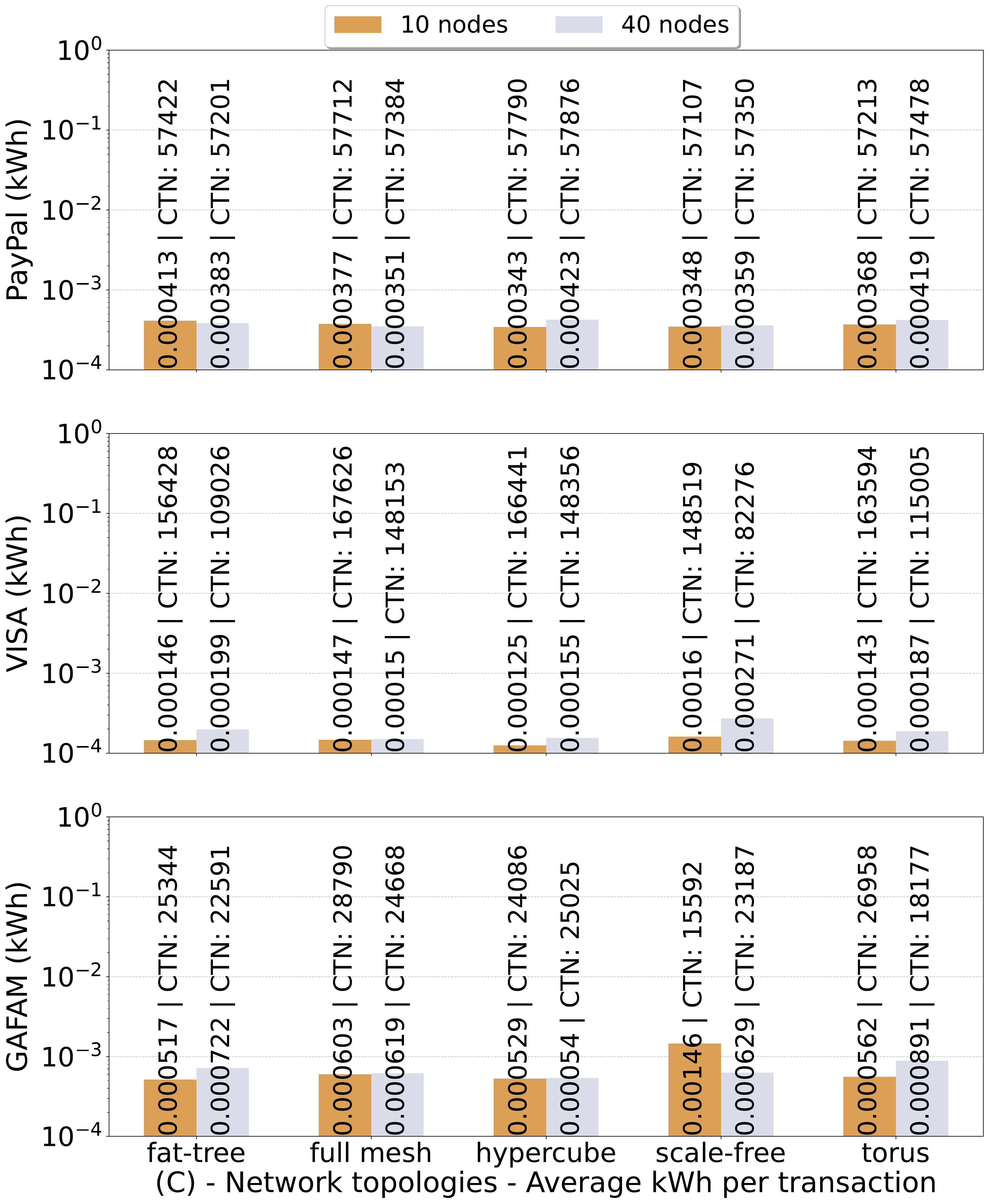
Algorand
Shows low energy per transaction across several topology and workload combinations, especially for transaction-processing workloads.
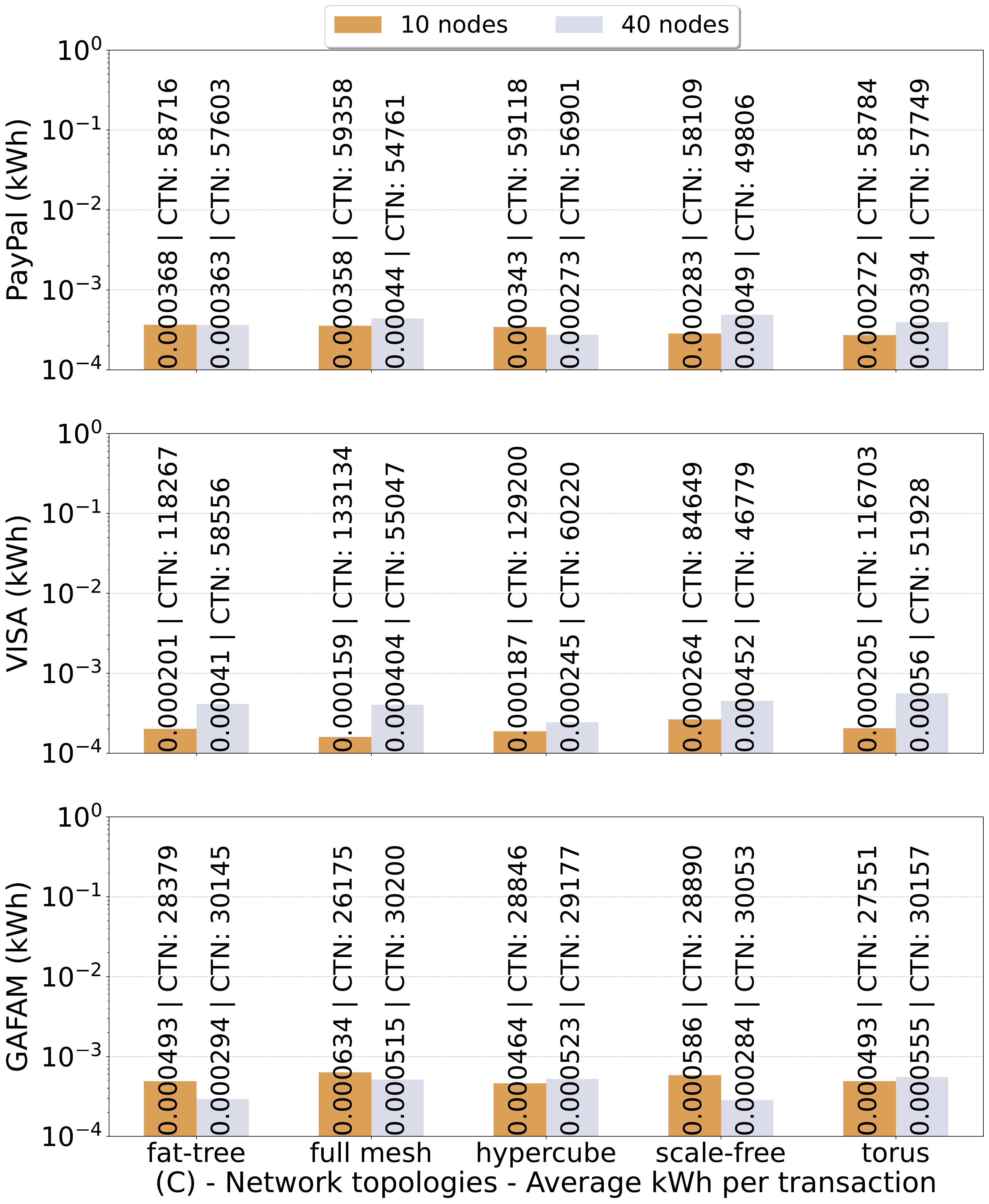
Diem
Highlights the energy profile of a permissioned BFT-style blockchain under topology-controlled execution.
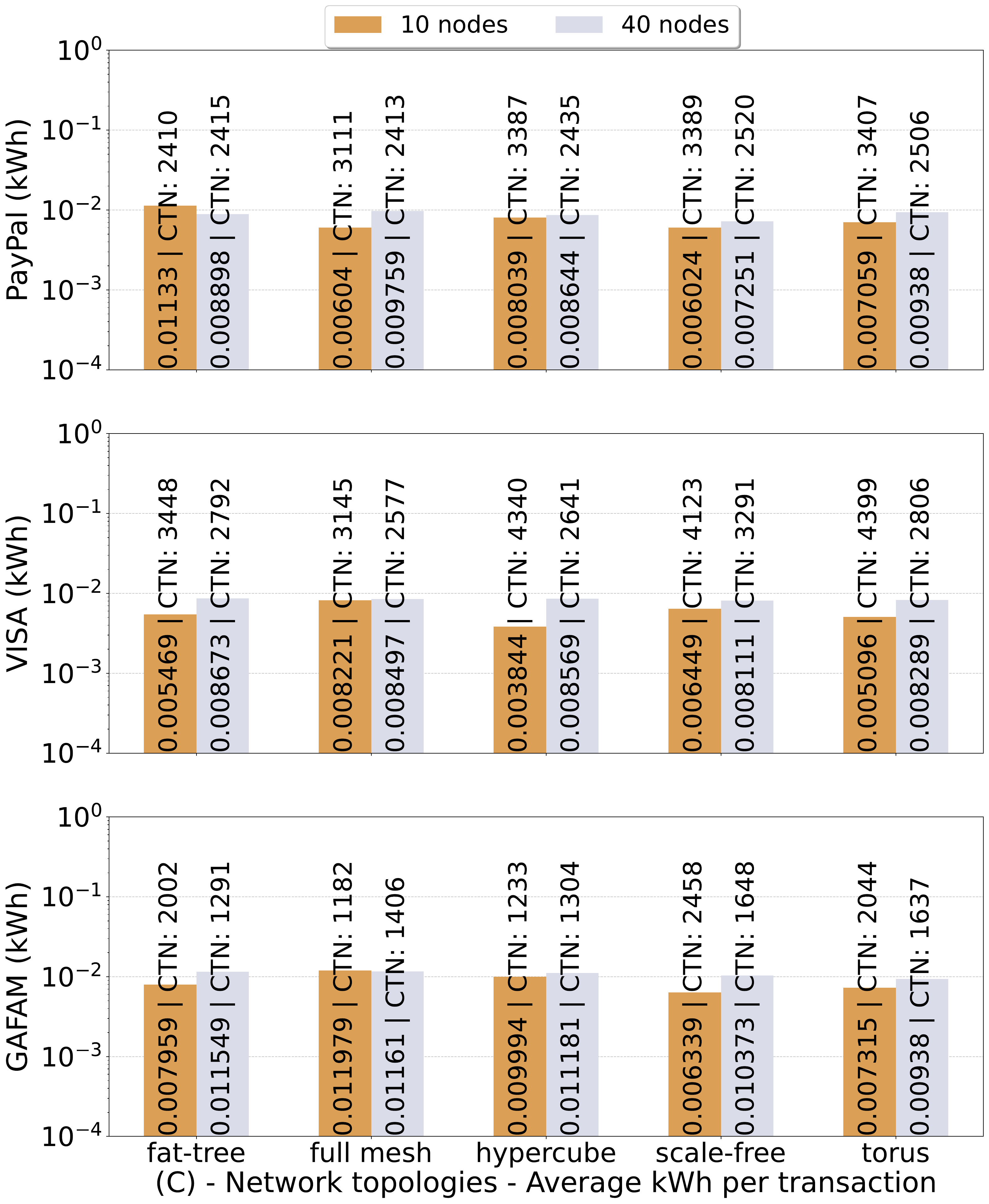
Ethereum Clique
Shows higher energy per transaction compared with the other evaluated systems, regardless of topology.
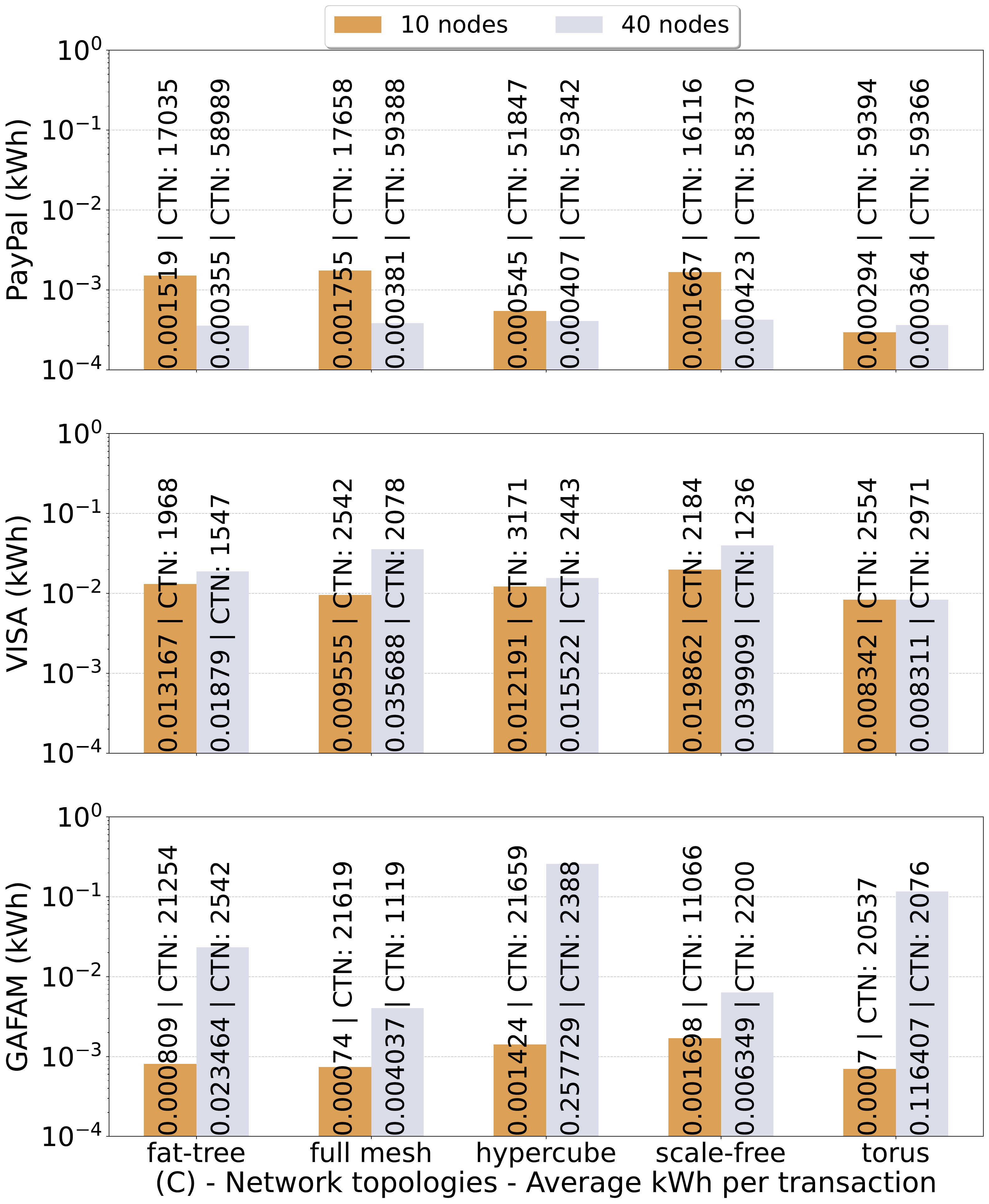
Quorum IBFT
Captures how a permissioned Ethereum-based system reacts to workload intensity and topology changes.
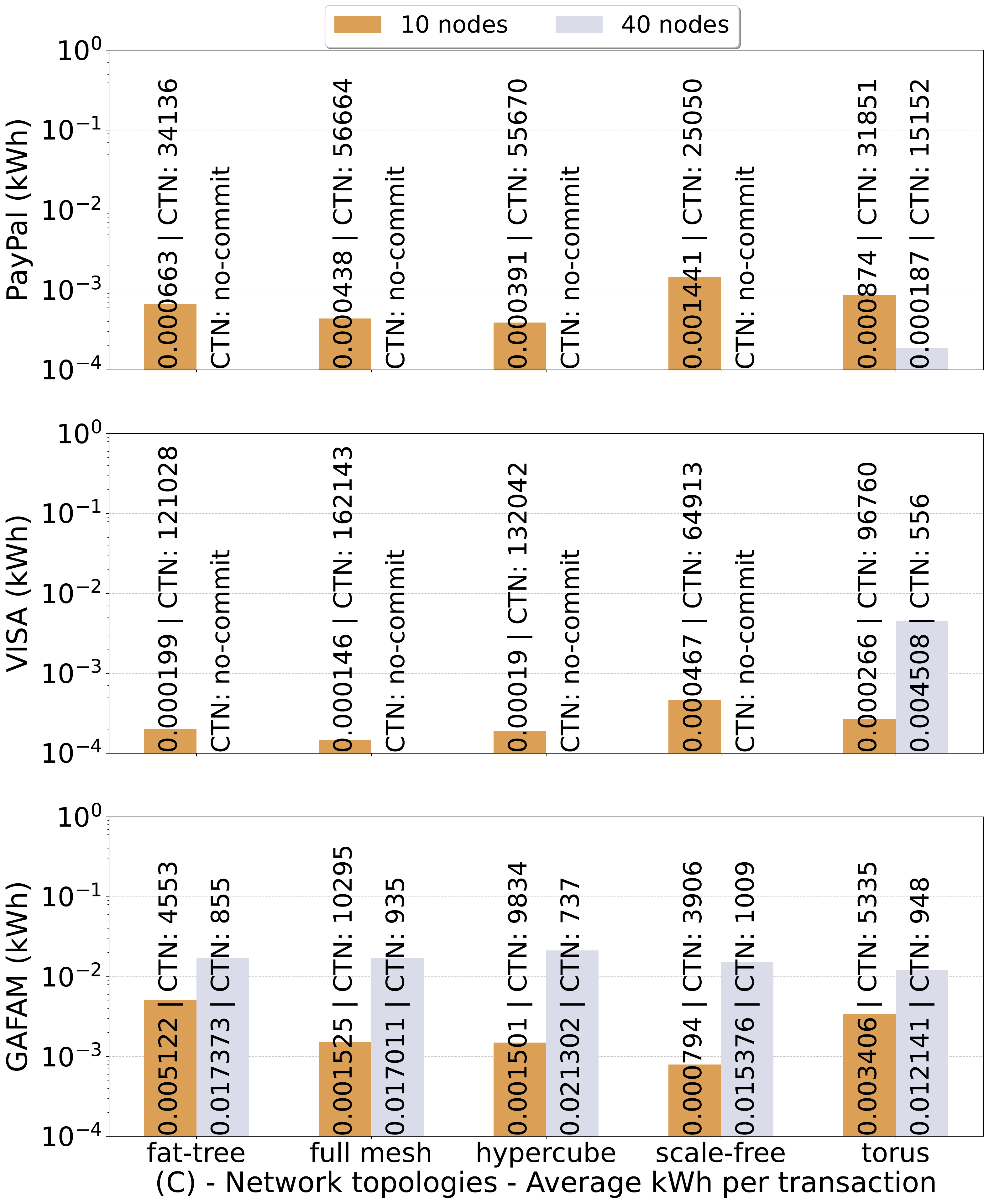
Solana
Shows competitive energy behaviour in smaller configurations, with scalability issues emerging in larger setups.
Main findings
- Fat-tree and full mesh generally provide the most energy-efficient network configurations across the evaluated blockchains.
- Algorand and Diem achieve the lowest energy consumption per transaction in several configurations.
- Ethereum Clique shows the highest energy per transaction among the evaluated systems.
- Quorum IBFT becomes more expensive under demanding workloads and larger configurations.
- Solana shows promising energy-per-transaction behaviour, but larger node configurations expose operational and scalability issues.
Relationship with the DEBS work
This paper is closely connected to the topology-aware benchmarking line of work. While the DEBS paper focuses more broadly on blockchain performance under network topologies and dynamics, this ICBC paper isolates the energy dimension and studies how topology affects energy consumption and energy per transaction.