Dynamic Taxonomy: A Bridge from DeFi to TradFi
CCAF Working paperThis work develops a dynamic taxonomy for decentralised finance, designed to connect DeFi with traditional finance, regulatory perspectives, and financial-market classification logic. The paper focuses on how DeFi protocols can be described through activities, actors, assets, and architecture, while also capturing protocol-level attributes that make DeFi different from traditional financial infrastructures.
4
taxonomy pillars
200
Ethereum protocols analysed
47
empirical characteristics
97.96%
Ethereum TVL coverage
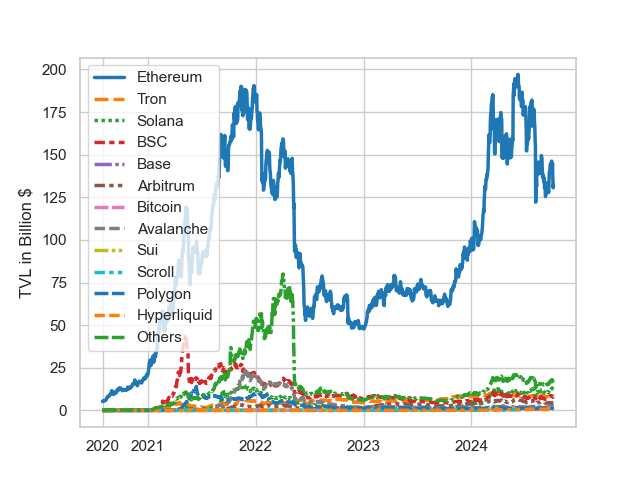
Why a DeFi taxonomy is needed
DeFi has evolved from blockchain-native financial experimentation into a complex ecosystem of protocols that increasingly resemble services known from traditional finance: lending, exchanges, index products, collateralised loans, payment services, derivatives, and asset management.
This creates a classification problem. DeFi is not simply a technical stack, but it is also not identical to TradFi. A useful taxonomy must therefore capture both sides: the financial function of a protocol and the blockchain-specific architecture through which that function is implemented.
Methodology
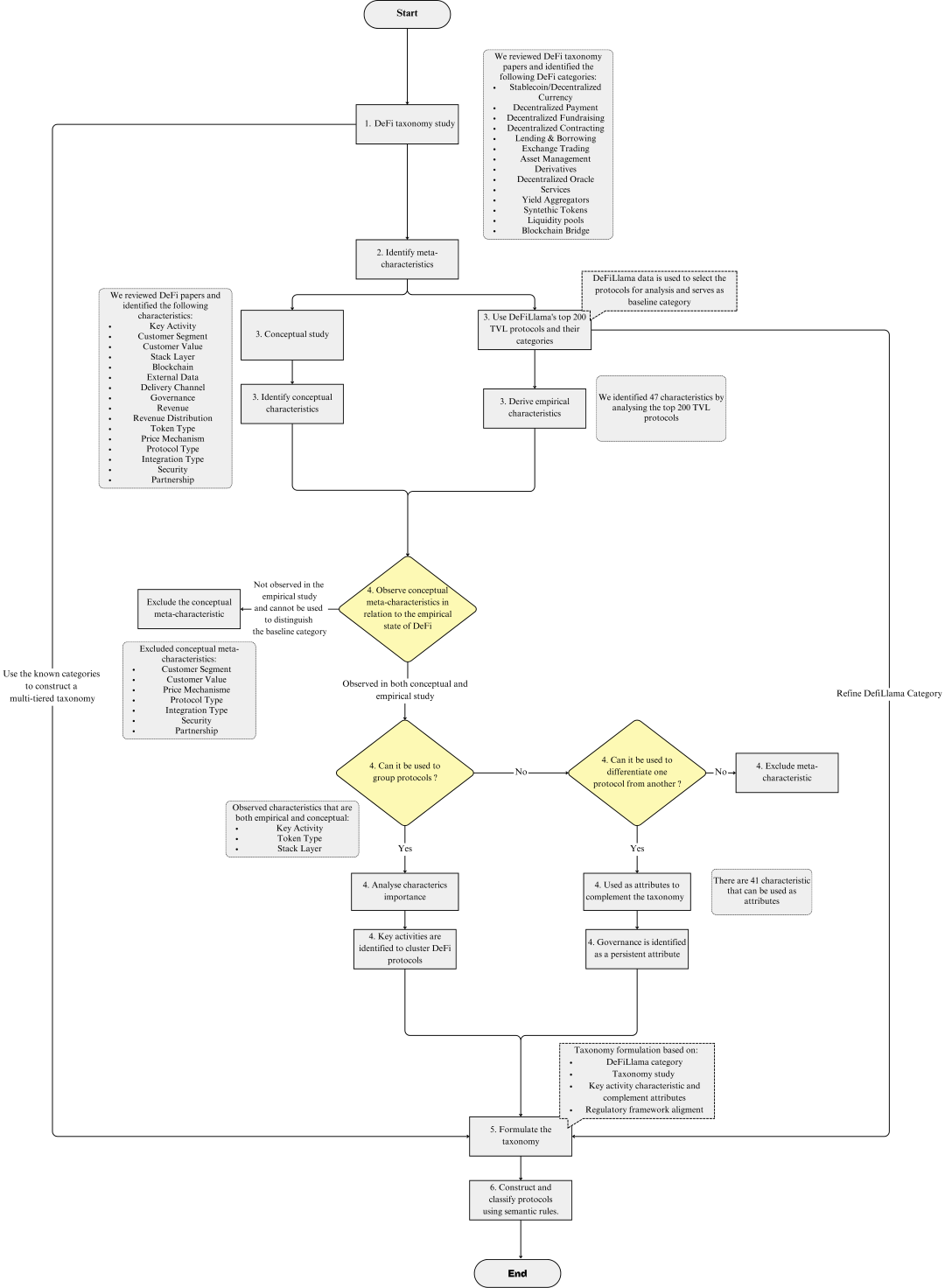
The taxonomy is built by combining literature review, conceptual analysis, empirical protocol inspection, and rule-based classification. The goal is not only to list DeFi categories, but to build a structure that can evolve with the ecosystem and remain useful for researchers, practitioners, and regulators.
Review existing DeFi taxonomy literature and identify previously proposed categories.
Extract conceptual meta-characteristics that can distinguish DeFi protocol types.
Analyse empirical protocol information, including web pages, documentation, governance, and third-party sources.
Use DeFiLlama data to prioritise relevant protocols, focusing on the top 200 Ethereum protocols by TVL.
Map categories, static attributes, and dynamic attributes into a structured taxonomy.
Develop semantic rules to classify protocols consistently.
The 4A taxonomy layer
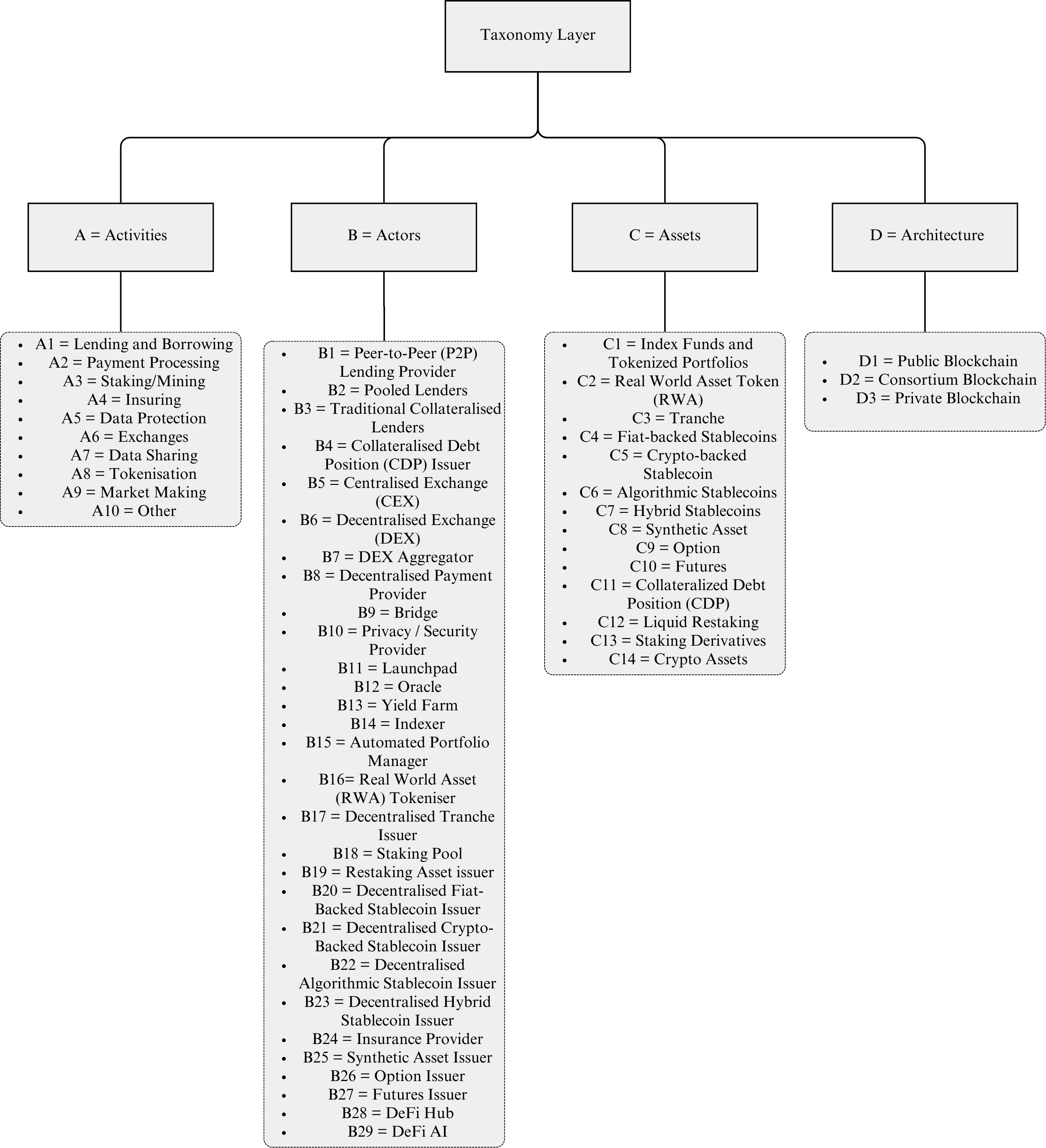
The high-level taxonomy organises DeFi into four main perspectives: Activities, Actors, Assets, and Architecture. This is the core bridge between the DeFi ecosystem and a TradFi-oriented understanding of financial services.
Activities
Actions or processes performed in the DeFi ecosystem, such as lending, payment processing, staking, insuring, exchanges, tokenisation, and market making.
Actors
Protocols, platforms, intermediaries, or service providers operating within DeFi, such as lenders, exchanges, bridges, oracles, yield farms, stablecoin issuers, and DeFi hubs.
Assets
Financial instruments or products that have value and can be traded, including cryptoassets, stablecoins, options, futures, tokenised portfolios, RWAs, and synthetic assets.
Architecture
The underlying blockchain infrastructure used to process DeFi transactions, classified across public, consortium, and private blockchain architectures.
From categories to machine-readable structure
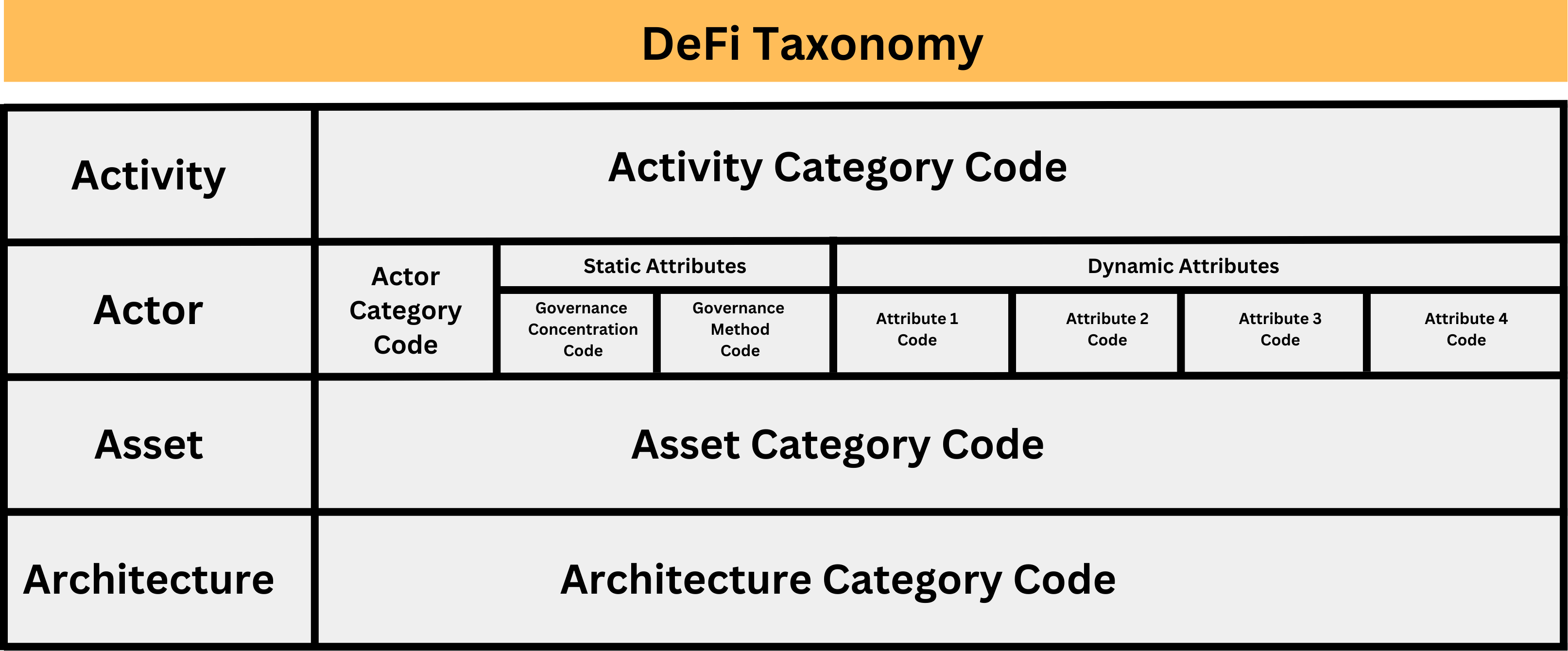
The taxonomy is designed as a structured tagging system. Each protocol can be described through activity, actor, asset, and architecture tags. This makes the taxonomy more useful than a static list of categories: it can support data exchange, protocol comparison, and integration with financial-infrastructure concepts.
Activity → A-category codeActor → B-category + static attributes + dynamic attributesAsset → C-category codeArchitecture → D-category code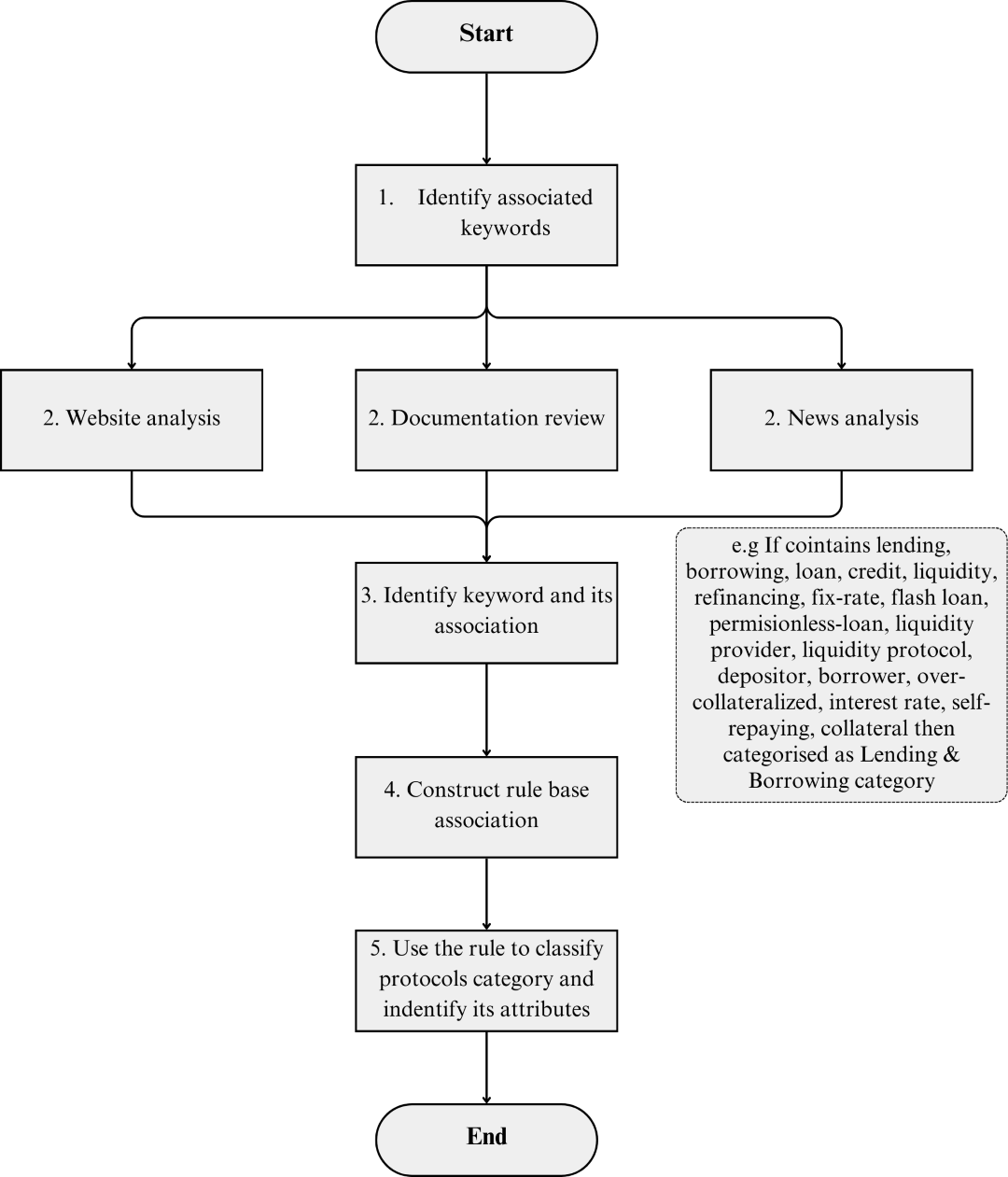
Semantic rules for protocol classification
A central part of the work is the development of semantic rules for classifying protocols. The rules are based on protocol websites, documentation, technical descriptions, governance information, and external sources. This allows the taxonomy to move from conceptual categories to reproducible protocol classification.
For example, a lending protocol can be identified through language related to liquidity provision, borrowing, supplying assets, collateralisation, interest-rate models, and liquidation mechanisms.
Cambridge DeFi Navigator
The taxonomy is connected to the Cambridge DeFi Navigator, an open-access CCAF digital tool for exploring the DeFi ecosystem through interactive visualisations. The Navigator provides a practical way to inspect DeFi categories, protocols, and ecosystem relationships beyond the static format of a paper.
If the embedded preview is blocked by the external website or by the browser, use the direct link below.
Main contribution
- Bridges DeFi and TradFi by designing a taxonomy that is readable for financial and regulatory audiences.
- Organises DeFi through four high-level perspectives: activities, actors, assets, and architecture.
- Combines conceptual taxonomy work with empirical protocol-level analysis.
- Introduces static and dynamic attributes to capture both general governance aspects and category-specific protocol features.
- Connects the taxonomy to the Cambridge DeFi Navigator as an open-access mapping and exploration tool.
Relationship with my CCAF experience
This work is directly connected to my research experience at the Cambridge Centre for Alternative Finance as Digital Asset Programme Intern / Digital Asset Research Intern. The page below describes the broader internship context, while this page focuses specifically on the taxonomy paper and the DeFi Navigator connection.